
Introduction to AI Search Optimization
AI search optimization is the practice of structuring, formatting, and positioning your content so that AI-powered search engines and large language models (LLMs) select it as a trusted source when generating answers for users. It sits at the intersection of three emerging disciplines: traditional SEO, Answer Engine Optimization (AEO), and Generative Engine Optimization (GEO).
To understand why this matters, it helps to understand how AI search engines work. Tools like ChatGPT with browsing enabled, Perplexity AI, and Google’s AI Overviews do not just retrieve links — they read, synthesize, and summarize content from across the web, then present a single coherent answer to the user. The sources they pull from are not random. They prioritize content that is authoritative, clearly structured, factually accurate, and written in a way that is easy to extract and summarize.
This creates a profound shift in how visibility works online. In traditional SEO, your goal was to rank on page one of Google. In AI search, your goal is to be the source that the AI cites. At Chirag Modi Digital Marketing, we describe this shift as moving from ranking to being referenced — and it requires a fundamentally different approach to content strategy.
Generative Engine Optimization (GEO) refers specifically to optimizing content for AI tools that generate responses — ChatGPT, Gemini, Perplexity, Claude, and similar platforms. Answer Engine Optimization (AEO) refers to optimizing for direct-answer features like Google’s featured snippets, People Also Ask boxes, and AI Overviews. Both work together in 2026’s search ecosystem, and both demand that your content be clear, credible, and consistently formatted.
Why AI Search Optimization Matters in 2026
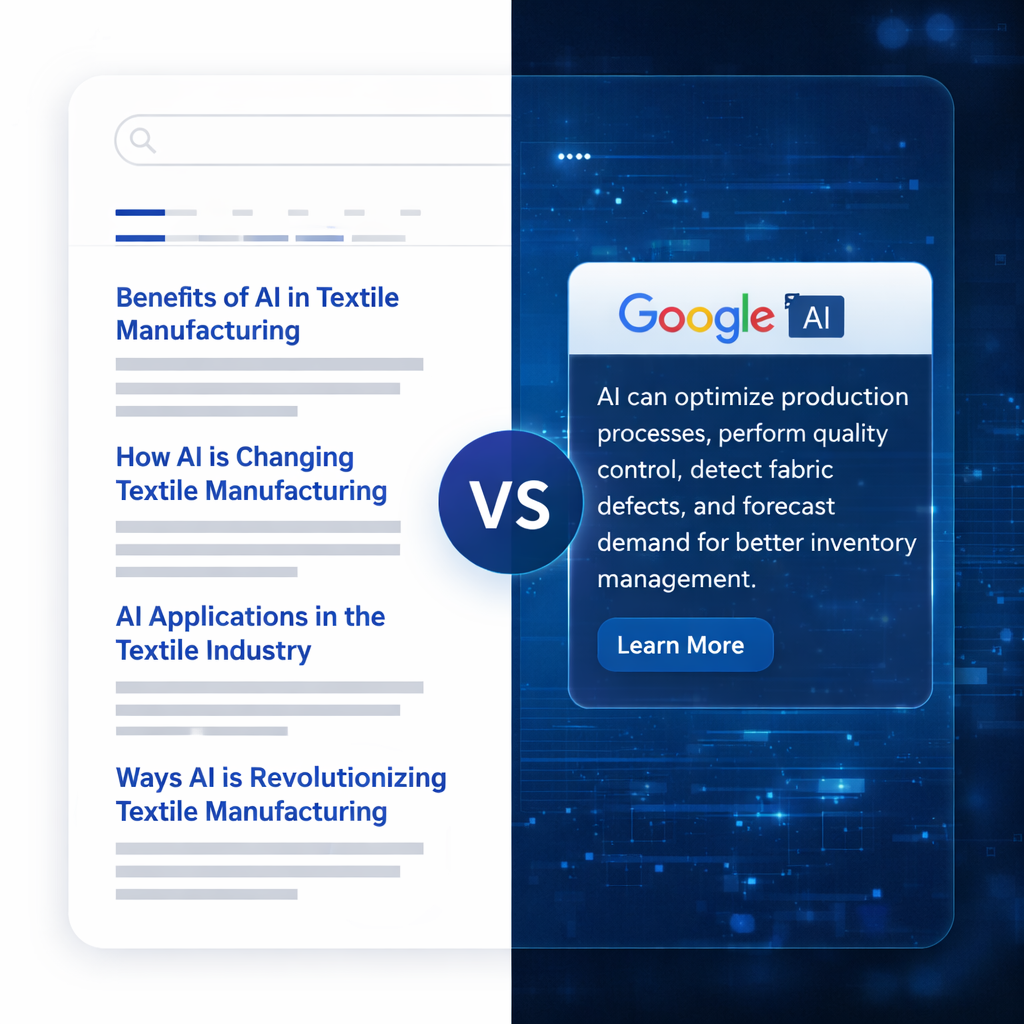
The numbers tell a compelling story. According to industry research, over 60 percent of Google searches in 2025 ended without a single click — users got their answer directly from the search results page. In 2026, that figure is even higher, driven primarily by AI Overviews appearing at the top of results for an increasing range of queries. At the same time, ChatGPT reached over 200 million weekly active users, and Perplexity AI became a mainstream research tool for professionals and students alike.
What this means practically is that millions of people are getting answers to questions that your business could be answering — without ever visiting your website. If an AI tool cites a competitor’s blog post instead of yours, that competitor gets the brand visibility, the credibility boost, and eventually the business. If your content is the one being cited, you become the authority in your niche in the eyes of both AI tools and the humans who use them.
There is also a compounding effect at work. AI models learn from patterns of citation. The more your content is cited and referenced across the web — by other websites, by AI tools, by authoritative sources — the more likely AI models are to cite it again in the future. This creates a virtuous cycle where early investment in AI search optimization pays increasingly larger dividends over time.
Chirag Modi Digital Marketing has seen this play out directly with clients. One of our clients in the B2B SaaS space saw a 47 percent increase in branded search traffic within three months of implementing a GEO-focused content strategy — not because they changed their Google ranking, but because their content started appearing in Perplexity answers and ChatGPT responses, driving users to search for their brand name directly.
Key Benefits of Optimizing for AI Search Results
Understanding the benefits of AI search optimization helps you make the case for investing in it — whether you are convincing yourself, your team, or your clients.
1. Brand Authority at Zero-Click Scale
When an AI tool cites your content to answer a user’s question, your brand name appears in front of that user even if they never click a link. This is brand exposure at a scale that traditional advertising cannot match — earned, not paid, and infinitely more trusted because it comes from a seemingly objective AI source. Over time, consistent AI citation builds brand authority that converts when users are ready to make a purchase decision.
2.Higher Quality Traffic
Users who arrive at your website after seeing your brand cited in an AI answer are pre-qualified. They already know who you are, they have seen your content validated by an AI tool, and they are typically further along in their decision-making process. At Chirag Modi Digital Marketing, we consistently see that traffic sourced from AI-driven discovery converts at a higher rate than cold organic traffic.
3.Competitive Differentiation
Most businesses in 2026 are still focused exclusively on traditional SEO. By investing in GEO and AEO strategies now, you gain a significant first-mover advantage in AI search visibility — occupying the space your competitors have not yet claimed. The brands that dominate AI search results in 2028 are the ones building the right foundations today.
4.Future-Proofing Your Digital Strategy
Search behavior is moving toward AI-mediated discovery at an accelerating pace. Optimizing for AI search now is not just about winning today — it is about building a content infrastructure that remains relevant and competitive as the search landscape continues to evolve. The structured, authoritative, clearly formatted content that AI tools love is also the content that performs best in traditional search.
5.Increased Featured Snippet and PAA Capture
The same strategies that help you get cited by AI tools — clear definitions, structured answers, FAQ schema, HowTo markup — also dramatically increase your capture of Google featured snippets and People Also Ask boxes. AI search optimization and traditional SERP optimization are not competing strategies; they are complementary ones.
How to Optimize for AI Search Results: Step-by-Step
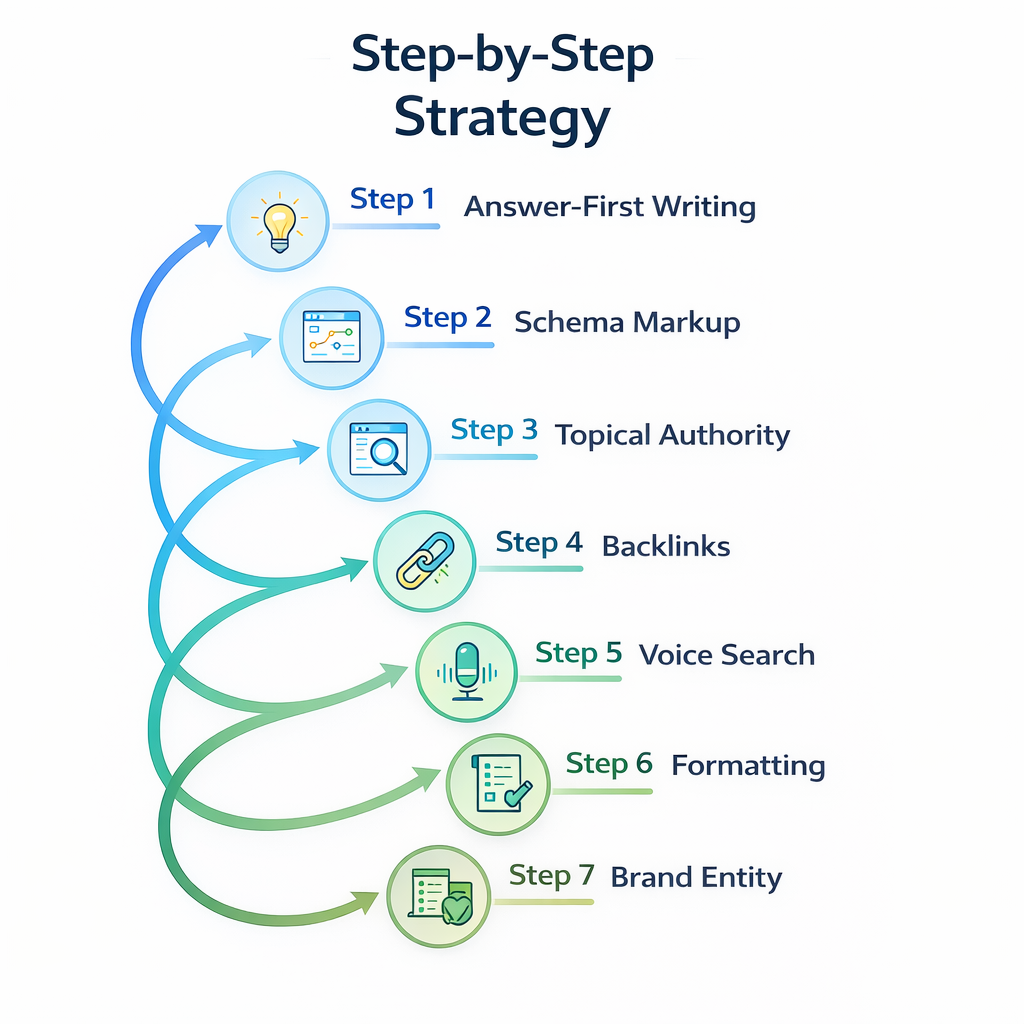
This is the core of everything. Based on years of experience at Chirag Modi Digital Marketing and the most current research on how LLMs select and cite content, here is the complete process.
Step 1 — Write Clear, Definitional Content That AI Can Extract
AI tools are, at their core, answer machines. They look for content that directly and clearly answers a question. Every major section of your content should begin with a direct, complete answer to the question implied by the heading — before elaborating with detail, examples, or nuance. Think of it as the inverted pyramid structure from journalism: lead with the answer, then provide the context.
For example, if your H2 is “What Is Generative Engine Optimization?” your first sentence should be a clean, complete definition — not a preamble, not a rhetorical question, not a vague teaser. AI models extract first sentences disproportionately. At Chirag Modi Digital Marketing, we call this “answer-first” writing, and it is the single most impactful change most content teams can make.
Step 2 — Implement Structured Data Markup
Structured data — also known as schema markup — is code added to your website that tells search engines and AI tools exactly what your content is and how to categorize it. For AI search optimization, the three most important schema types are FAQPage (for question-and-answer content), HowTo (for step-by-step guides), and Article (for editorial content with clear authorship and publication dates). These signals dramatically increase the probability that your content appears in Google AI Overviews and gets indexed by AI browsing tools.
Step 3 — Build Topical Authority Through Content Clusters
AI tools do not just evaluate individual pages — they evaluate the overall authority of a website on a given topic. A website that has twenty well-researched, interlinked articles on AI search optimization is far more likely to be cited than a website with one good article surrounded by unrelated content. Building a content cluster around your primary topic — with a pillar page supported by multiple related articles — signals deep topical expertise to both traditional search engines and AI models.
Step 4 — Earn Citations and Backlinks from Authoritative Sources
AI language models are trained on vast amounts of web data, and they learn which sources are trusted based partly on how often those sources are cited and linked to by other authoritative websites. Getting your content mentioned in Search Engine Journal, Moz, HubSpot, or other high-authority marketing publications tells AI models that your content is trusted by experts. This is why digital PR and strategic link building remain essential components of any GEO optimization strategy in 2026.
Step 5 — Optimize for Conversational and Voice Queries
AI search is inherently conversational. Users ask complete questions — “how do I get my content to appear in ChatGPT answers?” — rather than typing fragmented keyword strings. Your content must anticipate and directly answer these conversational queries. Include natural-language question-and-answer sections throughout your content, and write in a tone that mirrors how people actually speak and ask questions. This simultaneously improves your answer engine optimization performance and your voice search visibility.
Step 6 — Format Content Specifically for AI Extraction
Beyond what you write, how you format it matters enormously. Use short paragraphs of three to four sentences maximum. Use descriptive H2 and H3 headings that read like questions or clear topic statements. Include a “Quick Answer” or “Key Takeaway” box at the top of long-form content — this is the format AI tools most frequently extract and cite verbatim. Use bullet points and numbered lists where information is genuinely list-like, but keep them concise and specific rather than vague and general.
Step 7 — Build Strong Brand Entity Signals
AI models build associations between brand names and topics based on consistent signals across the web. To rank in ChatGPT or Perplexity for your area of expertise, your brand name needs to appear consistently — on your own website, in author bios, in external mentions, in press coverage, in social media profiles, and in citations from other websites. This is what Chirag Modi Digital Marketing refers to as “entity strength” — and it is one of the most underrated factors in LLM visibility.
Latest Trends and Insights: AI Search in 2026
The AI search landscape is evolving at a pace that requires marketers to stay actively informed. Here are the most significant trends shaping AI search optimization strategy in 2026.
Multimodal Search Is Mainstream
AI search tools in 2026 process not just text but images, audio, and video. Google Lens integrated with AI Overviews means visual content — infographics, product images, explainer videos — now contributes to AI search visibility. Brands that invest in high-quality visual content with descriptive alt text, captions, and transcripts have a significant edge in multimodal search results.
Perplexity and ChatGPT Are Becoming Primary Research Tools
A growing segment of professionals — particularly in technology, finance, marketing, and healthcare — now use Perplexity AI and ChatGPT as their default starting point for research, bypassing Google entirely for many queries. This makes LLM visibility a mission-critical concern for B2B brands whose buyers use these tools daily to evaluate vendors, compare solutions, and form opinions before ever visiting a website.
AI Overviews Are Expanding Across More Query Types
When Google first launched AI Overviews (then called Search Generative Experience), they appeared primarily for complex, research-oriented queries. In 2026, they appear across a much broader range of query types — including commercial, local, and even transactional searches. This means even businesses that primarily relied on product and service pages for rankings now need to think about AI overview optimization.
Freshness and Accuracy Are Non-Negotiable
AI tools — particularly those with real-time web access like Perplexity — heavily favor recent, accurate, frequently updated content. Publishing a great article and leaving it untouched for two years is no longer a viable strategy. Chirag Modi Digital Marketing recommends a quarterly content refresh schedule for any article targeting AI search visibility, updating statistics, adding new insights, and revising any information that may have changed.
Brand Mention Tracking Is the New Rank Tracking
In traditional SEO, you tracked keyword rankings. In AI search optimization, you track brand mentions — specifically, how often and in what context your brand is cited by AI tools. New tools are emerging in 2026 that allow marketers to monitor their AI search visibility, track citations across ChatGPT, Perplexity, and Gemini, and identify opportunities to improve their positioning. Chirag Modi Digital Marketing has integrated AI mention tracking into every client reporting dashboard we manage.
Challenges of AI Search Optimization
Optimizing for AI search results is powerful, but it comes with genuine challenges that every marketer needs to understand and plan for.
Lack of Standardized Metrics
Unlike traditional SEO, where you can track keyword rankings, organic traffic, and click-through rates with precision, AI search visibility is much harder to measure. There is no single tool that comprehensively tracks how often your content is cited across all AI platforms. This creates reporting challenges, particularly when trying to justify investment in GEO and AEO strategies to stakeholders who are accustomed to clear ranking metrics.
Rapid and Unpredictable Changes
AI search tools update their models, change their citation behavior, and introduce new features at a pace that makes traditional SEO algorithm updates look glacially slow. A strategy that works perfectly in Q1 may need significant revision by Q3. Staying current requires continuous learning, regular content audits, and the willingness to adapt quickly — all of which demand time and resources that smaller teams may struggle to allocate.
Content Quality Bar Is Extremely High
AI tools are remarkably good at identifying thin, generic, or poorly sourced content — and they simply do not cite it. The quality bar for content that earns AI search visibility is higher than for traditional SEO. Content needs to be genuinely expert, well-sourced, clearly written, and structured with precision. For brands accustomed to publishing high-volume, lower-quality content for SEO purposes, this requires a significant strategic and operational shift.
Over-Optimization Risk
Just as over-optimizing for Google’s algorithm can result in penalties, over-engineering content for AI extraction can backfire. Content that reads like it was written for a machine rather than a human — with mechanical answer-first structures on every single paragraph, forced schema on every page, and unnatural keyword density — signals low authenticity to both AI models and human readers. The goal is to serve humans well, in a format that AI can also easily process. Chirag Modi Digital Marketing always leads with human-first writing principles, then optimizes for AI extraction as a secondary layer.
Frequently Asked Questions
1.What is AI search optimization?
AI search optimization is the practice of structuring and formatting your content so that AI-powered search tools like ChatGPT, Perplexity, Google Gemini, and Bing Copilot select it as a trusted source when generating answers. It combines traditional SEO principles with AEO and GEO strategies specific to how large language models process and cite content.
2.How is GEO different from traditional SEO?
Traditional SEO focuses on ranking your pages in Google’s blue-link results by optimizing for keywords, backlinks, and technical performance. Generative Engine Optimization (GEO) focuses on getting your content cited within AI-generated answers — a fundamentally different goal that requires answer-first writing, structured data, topical authority, and strong entity signals rather than keyword density alone.
3.How do I get my content cited by ChatGPT or Perplexity?
To get cited by ChatGPT, Perplexity, or Gemini, your content needs to be authoritative, clearly structured, factually accurate, and frequently updated. Earning backlinks from high-authority websites, using structured data markup, writing in an answer-first format, and building strong brand entity signals across the web all significantly increase your chances of being cited.
4.Does structured data help with AI search rankings?
Yes. FAQPage, HowTo, Article, and Organization schema all send clear signals to AI tools about the nature, authority, and structure of your content. While structured data alone does not guarantee AI citation, it dramatically increases the probability — particularly for Google AI Overviews and featured snippet capture.
5.Is SEO still relevant in 2026 with AI search growing? Absolutely. Traditional SEO and AI search optimization are complementary, not competing. The authoritative, well-structured, high-quality content that performs best in AI search is also the content that ranks well in traditional Google results. Investing in both simultaneously is the smartest strategy for 2026.
Conclusion
The search landscape in 2026 is more complex, more competitive, and more exciting than it has ever been. AI search optimization is not a trend to watch from the sidelines — it is the central battleground for digital visibility right now. Brands that understand how to get cited by ChatGPT, how to appear in Google AI Overviews, how to implement generative engine optimization, and how to write content that AI tools genuinely trust are the brands that will define their industries online over the next three to five years.
The good news is that the foundations of great AI search optimization — expertise, clarity, authority, structure, and consistency — are the same foundations of great content marketing. You do not need to abandon what works. You need to build on it with the precision and intentionality that 2026’s AI-powered search ecosystem demands.
At Chirag Modi Digital Marketing, we specialize in helping businesses navigate exactly this shift — from traditional SEO thinking to a holistic, AI-ready content and visibility strategy. We have the experience, the frameworks, and the proven results to help your brand become the source that AI tools cite, recommend, and trust.

Ready to Dominate AI Search in 2026?
Do not let your competitors get cited while your brand stays invisible. Partner with Chirag Modi Digital Marketing today and let us build an AI search optimization strategy tailored specifically to your business, your audience, and your goals. Whether you are starting from scratch or looking to upgrade an existing SEO strategy, we are ready to help you lead in the new era of search.
Visit: chiragmodidigitalmarketing.com
Email: hello@chiragmodidigitalmarketing.com