 Book A Call
Ahmedabad has been the beating heart of India’s textile industry for over a century. From the iconic mills of the past to the modern fabric clusters in Naroda, Sindhi Market, and the Ring Road corridor, the city produces, processes, and exports textiles that reach garment manufacturers, home furnishing brands, and fashion labels across the globe. The craftsmanship is world-class. The production capacity is extraordinary. And yet, for too many textile businesses in Ahmedabad, growth has stalled — not because of quality or price, but because buyers simply cannot find them online.
This is the central challenge that digital marketing for the textile industry solves. In 2026, the way fabric buyers source their suppliers has changed permanently. Procurement managers in Mumbai, fashion brands in Europe, and garment exporters in Bangladesh are not flying to trade fairs to find new suppliers — they are typing queries into Google, scrolling LinkedIn, and asking AI tools like ChatGPT and Perplexity for recommendations. If your textile business is not visible in those moments, you are invisible to a growing segment of your most valuable potential buyers.
At Chirag Modi Digital Marketing, we have spent over twelve years helping businesses across industries build powerful digital presences — and in recent years, we have developed deep expertise in one of Ahmedabad’s most important sectors: the fabrics and textiles industry. We understand the language of GSM and MOQ, the rhythm of the textile trade calendar, and the specific buyer journey that takes a fabric sourcing manager from a Google search to a confirmed purchase order. In this guide, we are going to walk you through everything — from why digital marketing matters for your textile business in 2026, to the exact strategies that generate real B2B leads, export inquiries, and brand authority.
Introduction to Digital Marketing for Textile Industry Businesses in Ahmedabad
Digital marketing for textile industry businesses is the practice of using online channels — search engines, social media platforms, paid advertising, content marketing, and email — to connect textile businesses with buyers, distributors, and brand partners. It is fundamentally different from the generic digital marketing that a restaurant or a retail store might use, because the textile industry operates on different buying cycles, different decision-maker profiles, and different trust signals than consumer-facing businesses.
The textile buyer’s journey in 2026 is primarily digital. When a garment manufacturer in Tirupur needs a new fabric supplier for their next season’s production, they do not pick up a trade directory — they search Google. When a procurement manager at a European fashion brand is evaluating Indian fabric exporters, they check LinkedIn company pages, read case studies, and look for certifications on supplier websites. When a home furnishing brand in the UAE wants to source upholstery fabric from Gujarat, they use Google Ads to find suppliers, compare websites, and contact three or four manufacturers within the same afternoon.
This is the environment in which your textile business is either winning or losing every day — and most businesses in Ahmedabad’s textile clusters are losing by default, simply because they have not yet invested in the digital infrastructure that makes them findable, credible, and compelling to modern buyers. Chirag Modi Digital Marketing exists to change that — bringing the same strategies that drive visibility and lead generation for global brands to Ahmedabad’s textile manufacturers, fabric processors, yarn traders, and garment exporters.
The distinction between B2B and B2C digital marketing matters enormously in this sector. A fabric manufacturer selling to garment factories needs a fundamentally different strategy than a textile brand selling directly to consumers. B2B digital marketing for the fabric industry requires longer-form content that demonstrates technical expertise, LinkedIn presence that reaches procurement and sourcing professionals, SEO targeting the specific keywords fabric buyers type when they are ready to source, and trust-building content like certifications, factory tours, and case studies. At Chirag Modi Digital Marketing, we design every textile client’s strategy around their specific buyer profile and sales cycle.
Why Digital Marketing for the Textile Industry Matters More Than Ever in 2026
India’s textile and apparel industry is a global powerhouse — contributing approximately 2.3 percent of GDP, 13 percent of industrial production, and over 12 percent of the country’s total export earnings. Ahmedabad and Gujarat sit at the center of this ecosystem, producing woven fabrics, knit fabrics, technical textiles, home furnishing materials, and processed fabrics that supply both domestic garment manufacturers and international fashion supply chains. The opportunity is enormous. But so is the competition.
In 2026, three major shifts have made digital marketing for textile companies in India not just beneficial but essential for growth. First, trade fair attendance has never fully recovered to pre-pandemic levels. Buyers who discovered the efficiency of online sourcing during 2020 and 2021 have largely maintained those habits — reducing their reliance on physical trade fairs and increasing their dependence on online research and digital communication to evaluate and onboard new suppliers. This means that your digital presence — your website, your Google rankings, your LinkedIn profile, your Google My Business listing — has effectively become your trade fair booth. It is the first thing a buyer sees, and it determines whether they contact you or your competitor.
Second, the arrival of AI-powered search has changed how buyers find suppliers. Tools like ChatGPT, Perplexity AI, and Google Gemini are now being used by sourcing professionals to research suppliers, compare options, and generate shortlists — before they ever visit a website. If your textile business is not cited, mentioned, or recommended by these AI tools, you are missing an entirely new discovery channel that is growing faster than any other in the digital landscape. Chirag Modi Digital Marketing specializes in generative engine optimization (GEO) and answer engine optimization (AEO) strategies that ensure textile businesses are visible not just on Google, but across the entire 2026 search ecosystem.
Third, competition for textile buyers’ attention online has intensified significantly. Large B2B portals like IndiaMART, TradeIndia, and Alibaba have invested heavily in their own SEO and paid advertising — meaning that textile businesses relying solely on portal listings are competing for attention on platforms they do not own or control. Building your own direct digital presence — a well-optimized website that ranks on Google, a LinkedIn company page that attracts sourcing managers, a Google Ads campaign that drives direct inquiries — gives you a distribution channel that you own, that builds equity over time, and that is not subject to the commission structures or algorithm changes of third-party portals.

Key Benefits of Digital Marketing for Textile Industry — Fabric Manufacturers and Exporters
Understanding the specific, measurable benefits of digital marketing for the textile industry helps business owners and marketing managers make the case for investing in it — and understand what success actually looks like.
The first and most impactful benefit is consistent, predictable B2B lead generation. Unlike trade fairs, which generate a concentrated burst of leads two or three times a year, a well-executed digital marketing strategy generates inquiries every week — from garment manufacturers searching Google for fabric suppliers, from sourcing managers finding your LinkedIn company page, from export buyers clicking on your Google Ads. Chirag Modi Digital Marketing has helped a fabric manufacturer in Ahmedabad increase their qualified B2B inquiries by over three times within four months of launching a focused SEO and Google Ads strategy — without increasing their trade fair attendance or portal spend.
The second major benefit is export market expansion. For Ahmedabad’s textile exporters, export marketing for fabric manufacturers through digital channels opens markets that would be prohibitively expensive to penetrate through physical trade visits. Google Ads can be targeted to specific countries, languages, and buyer types — running campaigns that reach procurement managers in Turkey, fashion brands in Italy, or garment factories in Bangladesh with the same budget that would previously have covered a single trade show booth. Combined with a well-optimized export-focused website and a strong presence on LinkedIn, digital marketing creates a 24/7 sales infrastructure that works across time zones without a sales team on the ground.
The third benefit is brand differentiation in a commoditized market. Ahmedabad’s textile market is intensely competitive, and price is often the first conversation with a new buyer. Digital marketing — specifically branding, content marketing, and social media — allows textile businesses to compete on quality, reliability, and expertise rather than price alone. When a buyer discovers your business through a well-written blog post about technical textile innovations, sees your factory tour video on YouTube, reads your client testimonial page, and then arrives at your website to find a professional, well-organized product catalog, they are already pre-sold on your credibility before the first conversation. Chirag Modi Digital Marketing helps branding for textile companies in India that positions them as premium suppliers worthy of premium buyers.
The fourth benefit is measurable return on investment. Unlike trade fair spend — where ROI is difficult to attribute precisely — digital marketing provides granular data on every rupee invested. Google Ads shows you exactly how many clicks, impressions, and conversions your budget generated. SEO tracking shows which keywords are driving organic traffic and inquiries. Social media analytics show which content resonates with your target buyers. This data-driven visibility allows Chirag Modi Digital Marketing to continuously optimize campaigns for maximum efficiency — reducing cost per lead over time while increasing inquiry quality.
7 Digital Marketing Strategies That Work for Textile Businesses in Ahmedabad
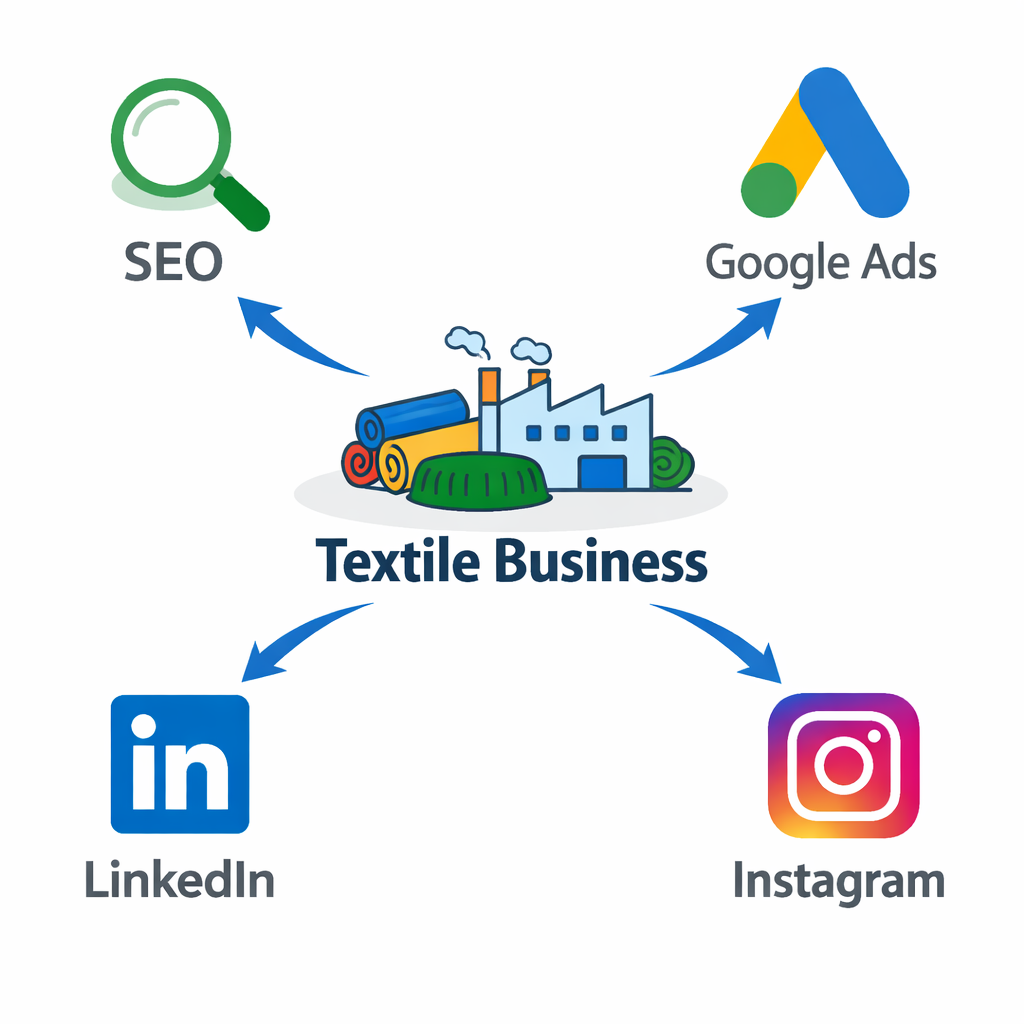
Chirag Modi Digital Marketing implements a comprehensive, integrated strategy for textile clients — covering every stage of the buyer journey from initial awareness to inquiry conversion. Here are the seven core strategies that consistently deliver results for fabric manufacturers and textile exporters in Ahmedabad.
SEO for Textile Company Websites is the foundation of long-term digital visibility. When a garment manufacturer types “woven fabric supplier Ahmedabad” or “100% cotton fabric manufacturer India” into Google, your website needs to appear on page one. SEO for textile companies in India requires keyword research specific to fabric categories and buyer search behavior, technical website optimization, product page optimization with accurate fabric specifications (GSM, composition, width, end-use), and content that demonstrates manufacturing expertise. At Chirag Modi Digital Marketing, our textile SEO strategy combines local Ahmedabad SEO with national and international keyword targeting — giving clients visibility across every relevant buyer segment.
Google Ads for Textile Business Ahmedabad delivers immediate, targeted visibility for high-intent buyer searches. Unlike SEO, which takes time to build, Google Ads campaigns can generate qualified inquiries within days of launch. We design Search campaigns targeting fabric sourcing keywords, Display campaigns for brand awareness in key export markets, and Performance Max campaigns for clients with textile e-commerce operations. Every campaign is structured around the textile buyer’s specific search language — not generic marketing terms.
LinkedIn Marketing for B2B Lead Generation is the single most effective social media strategy for textile exporters and B2B fabric manufacturers. LinkedIn gives you direct access to the decision-makers who source fabric — garment manufacturing heads, procurement managers, fashion brand owners, and buying house executives. Chirag Modi Digital Marketing builds and manages LinkedIn company pages that attract the right connections, creates thought leadership content that demonstrates textile expertise, and designs LinkedIn outreach campaigns that initiate conversations with qualified buyers — both domestically and in international markets.
Social Media Marketing for Fabric Manufacturers across Instagram, Pinterest, and WhatsApp Business plays a crucial role in building visual brand authority. Instagram is particularly powerful for showcasing fabric textures, colorways, and finished product applications — giving buyers a tangible sense of quality before they ever request samples. Pinterest drives significant organic traffic for home furnishing fabric businesses, interior textile brands, and fashion fabric manufacturers. WhatsApp Business, when integrated with a digital marketing strategy, becomes a powerful direct communication channel for sharing catalogs, updates, and inquiry responses with existing and prospective buyers.
Content Marketing for Textile Industry Authority involves creating blogs, videos, infographics, and guides that demonstrate your company’s expertise and attract organic search traffic from buyers doing research. Content topics like “How to Choose the Right GSM for Your Garment Application” or “What is the Difference Between Woven and Knit Fabric?” target buyers who are in the early stages of their sourcing research — building awareness and trust for your brand long before they are ready to place an inquiry.
Export Marketing for Fabric Manufacturers through digital channels involves optimizing your website specifically for international buyer audiences — including English-language content, clear export capability statements, certifications (OEKO-TEX, GOTS, BCI), and inquiry forms that international buyers trust. Combined with targeted Google Ads in export markets and LinkedIn outreach to international sourcing managers, a well-executed export digital marketing strategy can significantly expand a textile exporter’s international buyer pipeline without the cost of overseas trade visits.
Branding for Textile Companies in India through design, photography, and storytelling transforms commodity suppliers into branded partners that buyers prefer to work with. Chirag Modi Digital Marketing provides brand identity development, professional fabric photography direction, website design, and brand messaging that positions Ahmedabad textile businesses as premium, reliable, and differentiated — enabling them to command better prices and attract higher-quality buyers.
Latest Trends Shaping Digital Marketing for the Textile Industry in 2026
The digital marketing landscape for the textile sector is evolving rapidly, driven by technological change, shifting buyer behavior, and new platform capabilities. Several major trends in 2026 are creating new opportunities for Ahmedabad’s textile businesses.
AI-powered product discovery is transforming how fabric buyers research suppliers. Tools like ChatGPT, Google Gemini, and Perplexity AI are now being used by procurement teams to generate supplier shortlists, compare fabric options, and research manufacturing capabilities — entirely within the AI interface, before visiting any website. This creates a new visibility imperative for textile businesses: ensuring that your brand, your product categories, and your manufacturing capabilities are indexed, cited, and referenced by AI tools. Chirag Modi Digital Marketing implements GEO and AEO optimization strategies specifically for textile clients — structuring content so that AI tools can extract, cite, and recommend your business in response to fabric sourcing queries.
Short-form video is emerging as a powerful trust-building tool for textile manufacturers. Factory tour videos, fabric quality demonstrations, dyeing and finishing process showcases, and weaving room walk-throughs shot on a smartphone and posted to Instagram Reels, YouTube Shorts, and LinkedIn video generate enormous engagement from buyers who want to see the production environment before committing to a supplier relationship. Chirag Modi Digital Marketing helps textile clients develop a consistent short-form video strategy that builds buyer confidence and differentiates them from competitors with no video presence.
Social commerce integration is creating new revenue streams for textile businesses with retail or direct-to-designer sales models. Instagram Shopping, Pinterest Product Pins, and WhatsApp Commerce allow fabric brands to sell directly through social platforms — reducing friction for smaller buyers and designers who want to purchase sample quantities or small batch orders without going through a formal B2B inquiry process.
Voice search optimization is increasingly relevant for textile businesses targeting international buyers who search using voice queries on mobile devices and smart speakers. Queries like “fabric manufacturers in Ahmedabad India” and “cotton fabric exporters Gujarat” are now being typed and spoken — and content optimized for natural, conversational language performs significantly better for these searches than traditionally keyword-stuffed web copy.
Challenges of Digital Marketing for the Textile Industry — And How to Overcome Them
Even with the right strategy, digital marketing for textile companies in India comes with genuine challenges that are specific to the sector and require experience to navigate effectively.
The textile industry’s long B2B sales cycle is perhaps the most significant challenge. Unlike consumer purchases, a fabric sourcing decision involves sample requests, quality testing, price negotiation, supplier audits, and compliance checks — a process that can take weeks or months from first digital contact to confirmed purchase order. This means that digital marketing for textile businesses must be designed for nurture, not just conversion — building trust and staying visible across a long buyer journey rather than optimizing for immediate clicks. Chirag Modi Digital Marketing designs email nurture sequences, retargeting campaigns, and LinkedIn follow-up strategies specifically for textile clients’ long sales cycles.
High-quality visual content is non-negotiable in the textile sector, yet it is one of the most under-invested areas for Ahmedabad manufacturers. Fabric texture, drape, sheen, and colorway accuracy are critical buying signals — and they simply cannot be communicated through low-resolution mobile phone photos or stock imagery. Chirag Modi Digital Marketing guides textile clients through professional fabric photography, video production, and visual content strategy that does justice to product quality and commands the attention of serious buyers.
Competition from large B2B portals like IndiaMART and Alibaba presents a challenge for smaller manufacturers who feel they cannot compete for visibility. The solution is not to abandon portals — they still generate inquiries — but to build an owned digital presence that is not dependent on them. When your website ranks on Google’s first page for textile sourcing keywords, you receive direct inquiries that are not subject to portal commission structures, competitor listings, or algorithmic changes — giving you a sustainable, independent lead generation channel.
Frequently Asked Questions
What is digital marketing for the textile industry?
Digital marketing for the textile industry is the use of online channels — including SEO, Google Ads, LinkedIn, social media, content marketing, and email — to help fabric manufacturers, textile exporters, and garment suppliers generate B2B leads, build brand authority, and connect with domestic and international buyers. It replaces the dependence on trade fairs and word-of-mouth with a scalable, measurable, 24/7 digital sales infrastructure.
Which digital marketing strategies work best for textile companies in Ahmedabad?
The most effective strategies for Ahmedabad textile businesses are SEO for buyer-intent keywords, Google Ads for direct inquiry generation, LinkedIn for B2B outreach to garment manufacturers and sourcing managers, and content marketing showcasing fabric quality and manufacturing capabilities. The right mix depends on whether the business is targeting domestic buyers, export markets, or both.
How do textile exporters get international buyers through digital marketing?
Textile exporters attract international buyers by ranking on Google for export-intent keywords, running targeted Google Ads in key export markets, building a LinkedIn presence that reaches international procurement professionals, and optimizing their website for international audiences with certifications, clear export capability statements, and professional inquiry processes.
How long does it take to see results from digital marketing for a textile business?
Google Ads campaigns can generate qualified inquiries within days of launch. SEO shows measurable ranking improvements within three to six months. Social media and content marketing show compounding results over six to twelve months of consistent execution. Chirag Modi Digital Marketing provides monthly performance reporting so clients can track progress at every stage.
Is social media marketing useful for B2B textile companies?
Absolutely. LinkedIn is highly effective for reaching procurement managers and garment buyers directly. Instagram builds visual brand authority through fabric showcases and factory content. Pinterest drives significant organic traffic for home furnishing and interior textile businesses. WhatsApp Business supports buyer communication and catalog distribution. A well-planned social media marketing for fabric manufacturers strategy delivers meaningful B2B visibility and buyer engagement.
How much does digital marketing cost for a textile company in Ahmedabad?
Digital marketing packages for textile businesses in Ahmedabad typically range from ₹15,000 to ₹80,000 per month depending on scope — covering SEO, social media management, Google Ads, and content creation. Chirag Modi Digital Marketing offers customized packages aligned with each business’s size, growth goals, and target buyer profile. Contact us for a free consultation and custom proposal.
Conclusion
Ahmedabad’s textile industry has built its global reputation on one thing: the relentless pursuit of quality. The same commitment to excellence that goes into every meter of fabric your factory produces needs to be reflected in your digital presence — because in 2026, your website, your Google rankings, your LinkedIn page, and your social media content are the first thing a buyer sees. They form an impression of your business before they ever speak to your sales team, request a sample, or visit your factory. That impression determines whether they become your customer or your competitor’s.
The businesses that will define Ahmedabad’s textile industry in the next decade are the ones investing today — in SEO that makes them findable, in Google Ads that generates direct inquiries, in social media that builds visual brand authority, in content that demonstrates genuine expertise, and in the kind of digital infrastructure that works for them twenty-four hours a day across every time zone where their buyers operate. The future of digital marketing for textile industry growth in Ahmedabad belongs to businesses that act now — not later.
At Chirag Modi Digital Marketing, we combine twelve years of digital marketing expertise with deep, genuine knowledge of the fabrics and textiles sector. We understand your buyers, we speak your industry’s language, and we have the strategies, the tools, and the proven results to transform your textile business’s digital presence from invisible to indispensable.
Ready to Grow Your Textile Business with Digital Marketing in 2026?
Stop depending on trade fairs and portal listings to find your next buyer. Partner with Chirag Modi Digital Marketing — Ahmedabad’s specialist digital marketing agency for the fabrics and textiles industry — and let us build you a lead generation machine that works every day of the year.
Whether you need SEO that ranks your website for fabric sourcing keywords, Google Ads that puts your business in front of ready-to-buy garment manufacturers, LinkedIn marketing that opens doors with international procurement managers, or a complete digital strategy built specifically for your textile business — we are ready to deliver.